


Vertiv has expanded its liquid cooling portfolio in Europe, the Middle East and Africa with the launch of the CoolChip CDU 2300 and CoolChip Fluid Network Row Manifolds, extending its thermal management range for data centre operators in the region.
The new products target sites handling AI workloads and other high-density computing demands, where traditional air cooling is coming under increasing strain. They form part of Vertiv's broader thermal chain, spanning direct-to-chip cooling, immersion cooling, rear-door heat exchangers, coolant distribution, heat rejection, controls and related services.
The CoolChip CDU 2300 is a liquid-to-liquid coolant distribution unit with 2.3 MW of cooling capacity. Its compact footprint is intended to let operators place it in-row or in nearby mechanical areas, rather than using larger sections of white space for cooling equipment.
Vertiv's CDU range now spans from 100 kW to 2.3 MW and supports both direct-to-chip liquid cooling and rear-door heat exchangers. The CDU 2300 includes a controller that adjusts temperature and flow in response to workload demand, while supporting redundancy, communication between units and remote monitoring.
Those features are designed to help the unit operate as part of a wider liquid cooling installation rather than as a standalone component. For operators building denser racks, that kind of integration is becoming more important as cooling systems increasingly need to coordinate with power and control infrastructure across an entire hall.
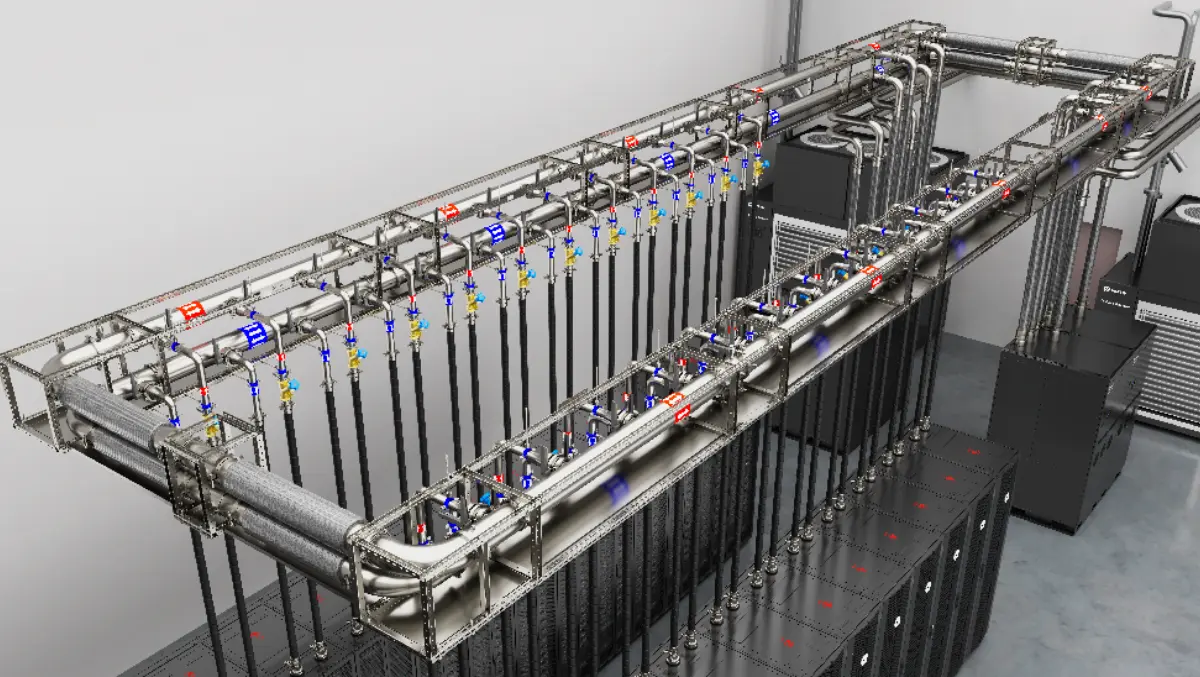
The second product introduced in EMEA, the CoolChip Fluid Network Row Manifold, acts as a connection layer between coolant distribution units, server-level cooling hardware and heat rejection systems. Each manifold assembly is flushed, passivated, pressure-tested and sealed before deployment.
The manifolds can be configured for direct-to-chip cooling, immersion cooling and rear-door heat exchanger setups. That flexibility is intended to simplify coolant routing in both new data centre builds and retrofit projects, where operators often need to add liquid cooling without redesigning the entire facility.
AI demand
The expansion comes as suppliers across the data centre sector respond to a sharp rise in demand for infrastructure that can support AI computing. Graphics processing units and other accelerators used for AI training and inference generate more heat than conventional server equipment, prompting operators to assess liquid cooling options as rack densities rise.
That shift is changing facility economics and layouts. More cooling capacity in a smaller footprint can help operators preserve white space for IT equipment, while modular distribution components can reduce the complexity of connecting server racks to liquid cooling loops.
Vertiv said its liquid cooling portfolio is backed by services covering design support, installation and maintenance. It presents that as part of a lifecycle approach to data centre cooling, particularly as liquid-based systems move from niche deployments into wider use in mainstream facilities.
Paul Ryan, president for EMEA at Vertiv, linked the launch to broader changes in data centre design. "The rapid growth of AI workloads is driving a fundamental shift in how data centres are designed, cooled, powered and operated," he said.
"At Datacloud Global Congress, we're showing how Vertiv is expanding its end-to-end portfolio, combining high-density power solutions, liquid cooling, heat rejection, intelligent controls, and lifecycle services, to help customers deploy AI-ready infrastructure faster and operate more efficiently over time," Ryan added.
Regional push
Making the two products available in EMEA suggests Vertiv is targeting regions where operators are upgrading existing sites as well as building new capacity. In many European markets, in particular, retrofitting established data centres to support denser AI infrastructure has become a pressing issue because land, power access and permitting constraints can make greenfield expansion difficult.
Liquid cooling suppliers have increasingly focused on systems that can be deployed in existing environments with limited disruption. Components such as compact CDUs and configurable manifold assemblies reflect that trend, as operators seek to add thermal capacity without major redesign work.
Vertiv said the CoolChip family forms a central part of its thermal chain architecture, tying together coolant delivery, heat capture and heat rejection across a single system. It said the row manifolds are designed to help operators scale liquid cooling infrastructure in weeks rather than months.