

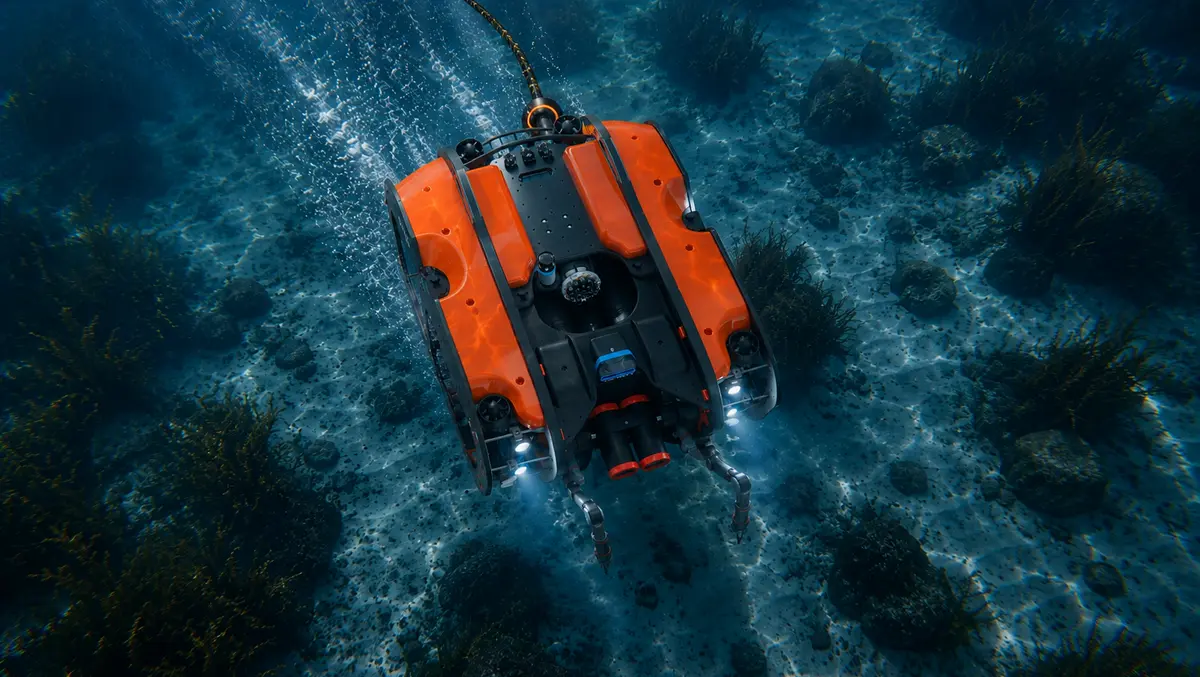
SYOS unveils SU10 underwater vehicle for subsurface use
Tue, 26th May 2026 (Today)
SYOS has introduced the SU10 uncrewed underwater vehicle, expanding its uncrewed range into the subsurface domain.
The vehicle is intended for maritime tasks including mine countermeasures, subsea infrastructure protection, surveillance and security. It can also support search, identification, route clearance, inspection and intervention missions, and operate alongside the group's air, land and surface systems.
The SU10 is part of SYOS's broader effort to offer connected uncrewed systems across multiple operating environments. It runs on AAIMS, the company's autonomy software, which serves as a common control layer across its vehicles.
Technical details released by SYOS state that the SU10 has an operating depth of 500 metres and a 10kg modular payload. It offers four hours of battery endurance, but can run indefinitely when connected to surface power.
The system uses an ultra-slim fibre-optic tether and can be launched from shore, a crewed vessel or a SYOS uncrewed surface vessel equipped with a launch and recovery system. Operators can control it remotely through a satellite communications link via a surface link, or locally from the launch point.
The vehicle is designed for high-flow, open-sea conditions and can transmit live data during missions. Its software allows operators to plan, task and re-task several vehicles across domains in real time rather than relying on post-mission analysis.
The launch gives SYOS a product line spanning air, land, sea and underwater systems. Headquartered in the United Kingdom and New Zealand, the company said earlier versions of the underwater platform have already been used in New Zealand's offshore oil and gas sector, as well as for pipeline survey, inspection and intervention work.
Chief executive officer and founder Sam Vye described the launch as a step forward for the company.
"The SU10 extends our portfolio undersea and strengthens SYOS as a provider of affordable interoperable uncrewed capability across land, sea, air and now subsurface. These are products that stand-alone as class-leaders, or operate as part of a connected, multi-domain uncrewed system - delivering operational effect from air to seabed, through our SYOS single autonomy stack, AAIMS. The SU10 enables rapid, scalable operations across both defensive and offensive mission sets. When paired with uncrewed surface vessels and uncrewed aerial systems it becomes part of a persistent offshore node that can deploy, coordinate and adapt, while keeping people out of harm's way," said Vye.
Software layer
AAIMS sits at the centre of SYOS's strategy to link different vehicles and payloads through a single software framework. The company describes it as an open-architecture system that works across platforms and lets operators manage missions in real time across several domains.
This reflects a wider trend in defence and maritime technology, where suppliers are seeking to combine surface, aerial and subsea assets into coordinated networks rather than offer standalone vehicles. In practical terms, the SU10 is being positioned as a tool that can integrate with surface and aerial systems for longer-duration maritime operations.
SYOS is also pursuing anti-submarine warfare applications through combinations of surface, subsurface and aerial systems. The company says a distributed group of uncrewed platforms can increase sensing density, improve detection and classification, and maintain surveillance over wider sea areas.
Research role
Beyond defence and security work, the SU10 is also set to be used in scientific activity. SYOS said the vehicle will be deployed in late 2026 on planned annual Antarctic missions for long-range under-ice mapping as part of an international research partnership.
That research role points to a dual market for subsea systems, where companies often sell similar platforms into both commercial and government programmes. Inspection, intervention and survey work in the energy sector has provided an established route to market for underwater vehicles, while naval demand has grown as governments place greater emphasis on seabed monitoring and the protection of offshore infrastructure.
Vye said the company's model is based on developing vehicles and software together while responding quickly to operational feedback.
"We're a business focused on building multi-domain solutions - designing vehicles and autonomy together, moving at pace through spiral development, informed by real-world feedback, to deliver advanced capability faster, and a significantly lower cost to capability ratio. That's the SYOS difference, advancing multi domain operational capability, delivering with speed to where it matters most," said Vye.