

.webp)
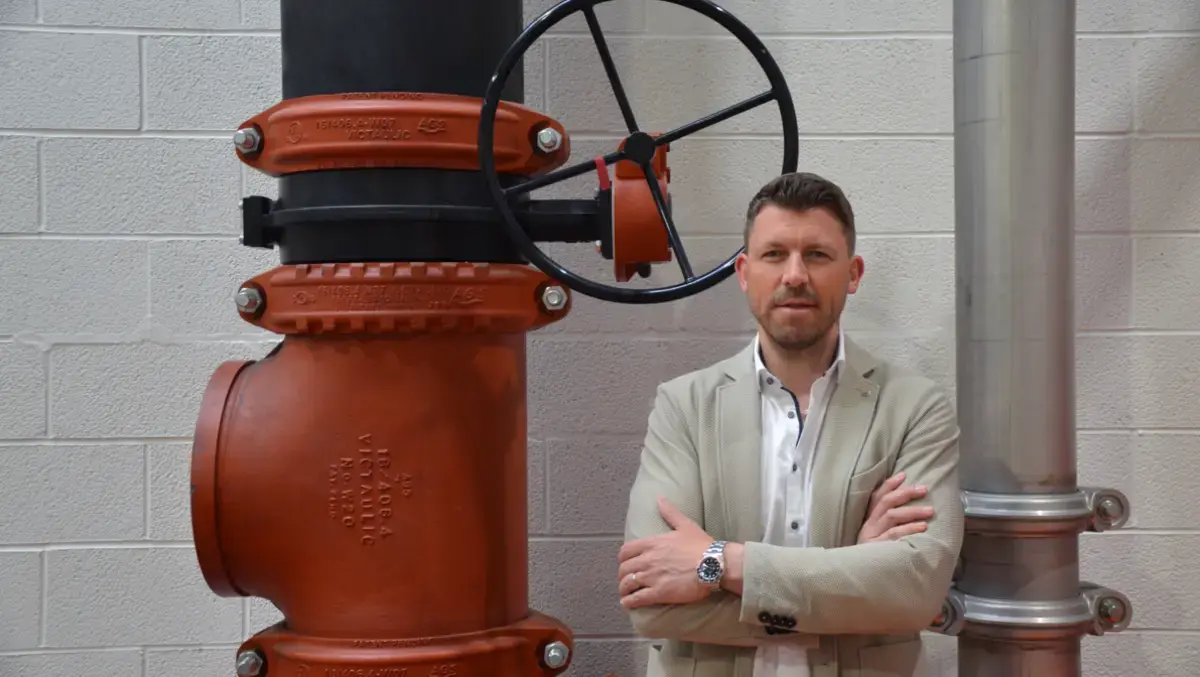
Victaulic has appointed Manuel Emmerich divisional business development manager for Europe, with a brief to bring the company into major projects at the pre-design stage.
He will focus on integrating grooved mechanical pipe joining systems into the early engineering phases of large construction and industrial projects across Europe. Target sectors include data centres, battery plants, healthcare and education buildings, high-rise developments, airports, commercial heating, ventilation and air conditioning systems, and industrial water infrastructure.
The appointment marks a shift in Victaulic's regional approach. Instead of concentrating on procurement-stage sales, it aims to work with project owners and consulting engineers during front-end engineering design, typically 12 to 18 months before construction starts.
The strategy builds on an Engineering Specialist model Emmerich introduced in 2022. It is designed to shape project specifications during the concept phase, so pipe joining methods are considered as part of the design process rather than left to a later purchasing decision.
Victaulic argues that earlier engagement gives owners and engineers a fuller basis for comparing grooved mechanical joining with more established methods such as welding or flanging. That review can cover total installed cost, project schedules, quality, safety and sustainability, while helping to reduce redesigns and avoid over-specification.
Under the model, Victaulic's technical teams can also advise on budget pricing, material management, design-build strategies, and engineering issues including thermal and vertical pipe stress analysis. The aim is to address potential design problems before work reaches site.
Early design
Earlier engineering input can also allow projects to be planned around prefabrication and modular assembly. Entire piping sections, including pumps and other equipment, can be assembled in a factory and delivered to site on modular skids for installation.
This can reduce labour demand on site and shift more work into controlled factory conditions. It can also improve safety and inspection processes by limiting the amount of fabrication and assembly required in the field.
Emmerich has worked at Victaulic for 13 years. He joined as a sales engineer in Cologne and later became regional manager, with responsibility for operations across western Germany and Switzerland.
Most recently, he oversaw the DACH region, covering Germany, Austria and Switzerland. His work implementing the engineering-led model in Central Europe has since become the template for a broader organisational structure across the continent.
The move comes as competition for large industrial and commercial projects in Europe increasingly hinges on delivery certainty, labour availability and design coordination. Developers of data centres, battery factories and transport infrastructure are under pressure to control schedules and reduce the risk of changes during construction.
Mechanical pipe joining systems are part of that discussion because they affect how quickly piping networks can be assembled, how much skilled labour is needed on site and how systems are maintained over time. By shifting the conversation into the design stage, suppliers such as Victaulic are seeking to influence decisions that were once made much later in the process.
A key part of Emmerich's brief will be to strengthen links between Victaulic's commercial teams and external engineering stakeholders. That includes consulting engineers and project owners involved in early planning decisions, where technical standards and construction methods are often set.
Victaulic employs more than 5,500 people and operates 55 facilities worldwide. The group sells pipe joining and flow control products into construction and industrial markets in more than 140 countries.
Explaining the case for earlier engagement, Emmerich said: "When we engage 18 months out, for example, we can have a broader conversation on budget pricing, material management in terms of design-build strategies and also assist with thermal and vertical pipe stress analysis to de-risk complex designs."
He added: "Piping systems are much more than just components or a piece of a larger puzzle, they can be leveraged as a strategic choice, where joining method directly impacts total project efficiency. Our goal is to provide owners and engineers with optimised designs, faster installations and a piping system that is easy to maintain. These efficiencies will lower cost, reduce risk, and improve system optimisation for the entire lifetime of the building."