


Quobly, Hon Hai launch quantum phase estimation toolbox
Thu, 14th May 2026 (Today)
Quobly and Hon Hai Research Institute have released an open-source toolbox for Quantum Phase Estimation, aimed at researchers studying fault-tolerant quantum computing.
The jointly developed numerical toolbox focuses on the Quantum Phase Estimation, or QPE, algorithm, which is used to calculate ground-state energies of molecular systems on future fault-tolerant quantum computers. It is intended to address a lack of practical resource estimates and performance trade-offs in simulations beyond small-scale models.
QPE is a well-known algorithm in quantum computing research, with potential applications in quantum chemistry and materials science. But simulating it in realistic settings has remained difficult, leaving researchers with limited ways to test how design choices affect circuit depth, gate counts, and error sources.
The toolbox is designed as a practical environment for exploring the full QPE workflow, from chemistry preprocessing to phase estimation. It gives users a way to examine algorithmic building blocks and implementation constraints while staying within problem sizes that classical computers can still handle.
How it works
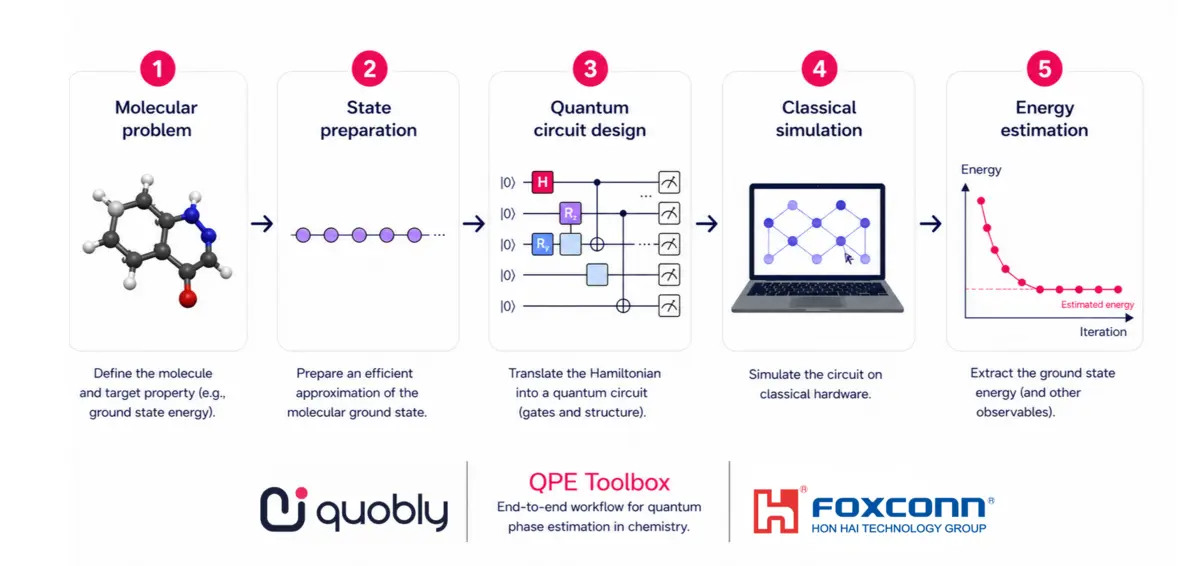
The software is built on tensor-network techniques and uses the open-source quimb library. It also connects with quantum chemistry tools including PySCF, allowing it to fit into existing research workflows.
Users can prepare physically motivated initial states using DMRG and matrix product states, and encode molecular Hamiltonians into quantum circuits through trotterisation or block-encoding and qubitisation methods. The toolbox also supports comparisons between textbook QPE and single-ancilla Robust Phase Estimation, or RPE.
Rather than trying to simulate early fault-tolerant quantum computers directly, the software focuses on numerical experiments that remain interpretable and feasible on classical machines. This allows researchers to test the effects of choices such as initialisation fidelity and Hamiltonian encoding strategy in greater detail.
Illustrative use cases include full circuit executions for about 10 to 20 qubits and circuits ranging from fewer than 1,000 gates to about 100,000. The toolbox can also support ground-state preparation and Hamiltonian encoding for systems of roughly 20 to 30 qubits, usually within a few hours or less on a standard laptop.
Research focus
The first release is positioned as an educational and exploratory framework rather than a production system. Its emphasis is on helping researchers build intuition about how QPE and related methods behave in practice, especially where theoretical proposals meet implementation limits.
That approach reflects a broader issue in quantum computing research. Many algorithms have strong theoretical foundations, but turning them into practical workflows often depends on fine-grained trade-offs that are hard to capture in abstract cost models alone.
The software has been released as open source and is free for academics and researchers to use. It is intended to develop with input from the research community.
Future work is expected to include variational circuit synthesis, compressed fermionic encodings, and larger-scale tensor-network simulations. Those additions would widen the range of numerical experiments available to researchers working on quantum algorithm design.
Quobly is based in France and focuses on silicon-based quantum computing. Hon Hai Research Institute is the research and development arm of Hon Hai Technology Group, also known as Foxconn.
Thibaud Louvet, Quantum Algorithms Scientist at Quobly, described the purpose of the software in practical terms. "Our goal is to provide a practical, numerical playground for QPE, one that helps researchers move beyond purely theoretical cost models and develop realistic intuition for fault-tolerant quantum algorithms," Louvet said.
Min-Hsiu Hsieh, Director of the Quantum Computing Research Centre at Hon Hai Research Institute, said the software was designed to give researchers a clearer view of implementation demands. "By combining state-of-the-art quantum algorithms with advanced tensor-network techniques, this toolbox offers researchers a structured environment to explore and better understand the practical requirements of future quantum applications," Hsieh said.