

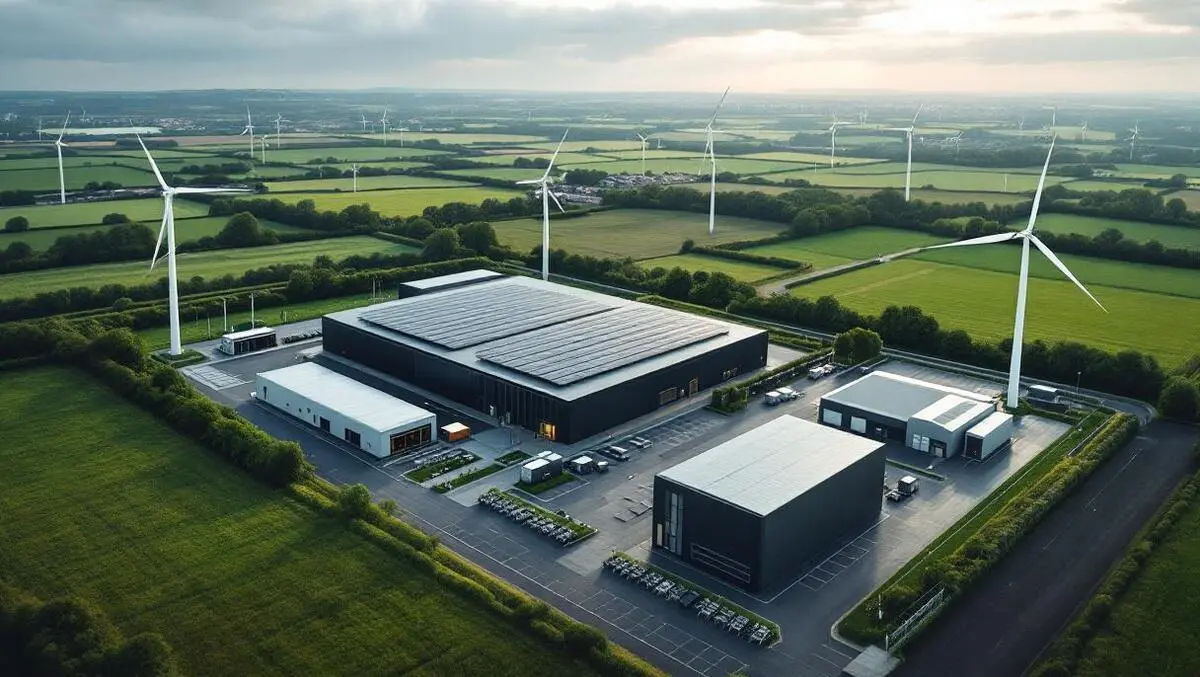
Ireland unveils strict new rules for data centre power use
Fri, 30th Jan 2026.webp)
The Irish government has introduced a new framework to balance the rapid expansion of data centres with national energy and climate goals.
Ireland has formally ended a three-year de facto moratorium on connecting new data centres to the electricity grid, marking a significant shift in its industrial and energy policy. The Commission for Regulation of Utilities (CRU) published a final decision in December 2025 that establishes strict new criteria for any facility seeking a connection. This move is designed to provide clarity to a sector that now consumes 21% of the country's total metered electricity, a figure that exceeds the consumption of all urban households combined.
The government aims to secure the economic benefits of being a global technology hub while ensuring that the surge in demand does not lead to rolling blackouts or the failure of national decarbonisation targets.
Strategic importance
For more than a decade, Ireland has served as the European headquarters for the world's largest technology companies. The presence of major cloud infrastructure from firms such as Amazon, Google, Microsoft, and Meta has anchored the country's foreign direct investment strategy. These facilities are the backbone of the digital economy, supporting thousands of high-value jobs and contributing significantly to corporation tax revenues. The government views data centres not merely as buildings full of servers but as essential infrastructure that enables other sectors, including pharmaceuticals and finance, to operate. Maintaining this status is a priority for IDA Ireland, the state agency responsible for attracting international investment.
Grid constraints
The rapid growth of the sector created a crisis for the national electricity grid, particularly in the Greater Dublin Area. By 2021, the sheer volume of connection requests threatened to overwhelm the system's capacity to distribute power reliably. EirGrid, the state-owned grid operator, warned that the unchecked expansion of data centres could lead to a deficit in generation adequacy. This led to a period of restricted growth where new applications were effectively stalled while the state reviewed its long-term strategy. The 2021-2025 moratorium was a reactive measure to ensure that energy remained available for homes, hospitals, and schools.
New conditions
The revised policy replaces the blanket restrictions with a tiered system based on energy demand. Data centres seeking more than 10 MVA of capacity must now provide their own onsite dispatchable generation or storage. This means a developer must build a power plant or a large-scale battery system alongside the data centre that is capable of matching its full electricity demand. These onsite assets must also be capable of feeding power back into the national grid during times of peak demand or system stress. This requirement ensures that the industry becomes a partner in grid stability rather than just a consumer of energy.
Renewable mandates
Sustainability is a central pillar of the new framework. All new data centres with a capacity of 1 MVA or more must prove that at least 80% of their annual electricity demand is met by new renewable energy projects located within the Republic of Ireland. Companies have a six-year window from the date they begin operations to meet this target. This "glide path" approach encourages the industry to sign corporate power purchase agreements (PPAs), which directly fund the construction of new wind and solar farms. By linking grid access to renewable investment, the government hopes to accelerate the national transition to green energy.
Regional distribution
A key element of the government's plan is to move data centre development away from the congested Dublin region. The Large Energy User Action Plan (LEAP), approved in January 2026, promotes the creation of "green energy parks" in regional locations. These parks are intended to co-locate energy-intensive industries with renewable energy sources, such as offshore wind projects on the west coast. This geographical shift aims to utilise underused parts of the national grid and spread the economic benefits of the tech sector more evenly across the country. Projects located in unconstrained regions are likely to receive priority in the application process.
Operational oversight
The CRU has introduced rigorous reporting requirements to ensure compliance with the new rules. Data centre operators must submit annual reports detailing their carbon emissions and renewable energy usage. If a facility fails to deliver its promised onsite generation or meet its renewable targets, the system operators have the authority to reduce its permitted power intake. This regulatory oversight is designed to prevent "project splitting," where developers might try to bypass the rules by submitting multiple smaller applications for a single large site. The policy treats any project according to its total aggregate demand.
Future outlook
The government's stance reflects a pragmatic acceptance that data centres are a permanent and growing feature of the Irish economy. Projections suggest that the sector could account for 30% of national electricity demand by 2032. While environmental groups express concern over the impact on climate targets, the state is betting on a "plan-led" approach to mitigate these risks. By mandating onsite generation and renewable investment, Ireland is attempting to create a model where digital infrastructure supports, rather than hinders, the national energy transition. The success of this strategy will depend on the speed at which both data centres and new renewable projects can be integrated into a modernised national grid.