

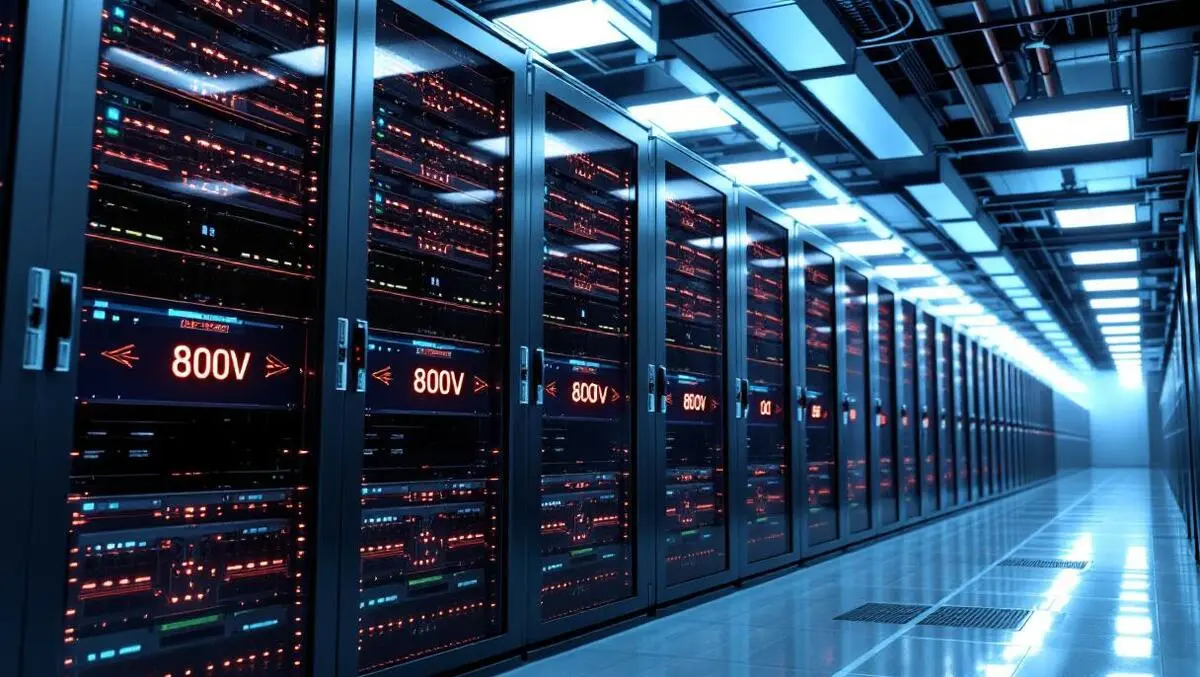
Enteligent backs 800V DC-native power for AI data centres
Thu, 12th Mar 2026
Enteligent has published a technical white paper calling for a shift in data centre electrical design: distributing 800V direct current (DC) across a facility and converting it to 50VDC at the rack.
The paper focuses on power-delivery constraints in AI and GPU-heavy environments. It points to rack power levels rising beyond 100kW and links that trend to larger site deployments in the hundreds of megawatts, with some planning assumptions extending to gigawatt-scale builds.
Enteligent presents the approach as an alternative to conventional alternating current (AC) architectures, arguing that AC-based electrical infrastructure is reaching practical limits as power density increases and operators try to fit more compute into the same footprint.
DC distribution
The architecture distributes power at 800VDC within the facility, then converts it to 50VDC within each rack. The paper describes this as a better match for modern servers, which already rely on internal DC power rails.
It also positions the design as a way to reduce conversion losses by centralising AC-to-DC conversion into fewer, higher-utilisation systems and using rack-level converters for the final stage of power delivery to IT equipment.
"AI is fundamentally reshaping data center power requirements. While 800VDC distribution solves the upstream limitations of traditional AC infrastructure, converting it directly to a 50VDC server bus within the rack addresses the final conversion bottleneck at the server level," said Sean Burke, CEO of Enteligent.
"The combination of 800VDC facility distribution with rack-level 800VDC-to-50VDC conversion represents a complete, DC-native power architecture that aligns with the realities of modern data center requirements," Burke added.
Efficiency claims
The paper links electrical efficiency to thermal performance, describing each conversion step as wasted energy that becomes heat inside the rack. That heat increases the cooling burden and can reduce the share of a site's footprint that operators can dedicate to compute.
Enteligent argues that the best results come from adopting high-voltage DC as the facility standard and pairing it with rack-level 800VDC-to-50VDC conversion, framing the combination as a complete "DC-native" stack for AI-scale data centres.
The white paper also makes a revenue-based argument around power density, claiming an AI rack built on a DC-native architecture can generate 10x to 15x more revenue than a traditional rack in the same square footage. The announcement does not include the supporting calculations, but the claim reflects a broader shift in the sector where available power and cooling increasingly determine how much infrastructure can be monetised within a facility.
One partner quoted in the announcement is Claros, which describes itself as a power-management platform company developing power-delivery technologies for data centres. Frank Smith, Claros' VP of Growth, links efficiency improvements to site economics.
"Power density is revenue density, and this architecture unlocks both. Every percentage point of efficiency recovered from unnecessary AC conversion translates directly into lower operating costs, reduced cooling infrastructure, and more usable compute per square foot of data center floor space," said Frank Smith, VP of Growth, Claros.
Smith also said: "Claros and Enteligent share the same perspective that by eliminating 15 to 20 kW of wasted heat per rack, you address one of the more persistent cost and scaling barriers for AI and GPU data centers."
Rack conversion
Beyond AI infrastructure, the paper argues that rack-level conversion could provide a common electrical platform across workload types, including enterprise and storage servers as well as GPU compute and newer AI systems.
The report builds on Enteligent's earlier research into facility-level 800VDC power delivery, which examined efficiency, total cost of ownership, and scalability for next-generation AI data centres.
Enteligent develops DC power infrastructure for high-density loads, including data centres and electric vehicle charging. It says its products are based on a proprietary DC-DC platform and aim to reduce AC conversion steps in power-delivery chains.
The company has increasingly focused on the constraints operators face as they plan higher-density racks and larger campuses. The white paper adds to a growing body of industry material that treats power conversion, heat removal, and space constraints as connected challenges rather than separate engineering domains.
Enteligent presents the 800VDC-to-50VDC approach as a path to higher rack power density as electrical losses and thermal limits become defining factors in AI data centre design.