

ZutaCore debuts single-slot liquid cooling for PCIe AI GPUs
Wed, 18th Mar 2026
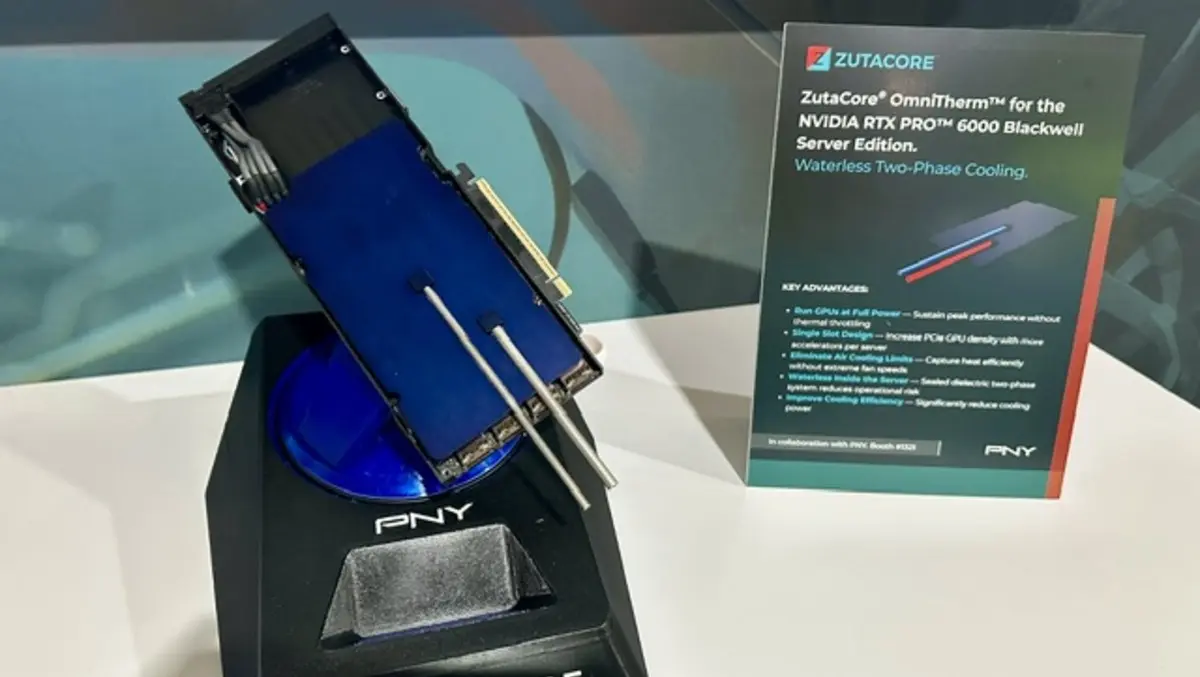
ZutaCore has launched a single-slot cold plate for servers built with Nvidia's RTX PRO 6000 Blackwell Server Edition GPUs, as data centre operators look for alternatives to air cooling in PCIe-based AI systems.
The product, called OmniTherm, uses a waterless two-phase liquid cooling approach and targets enterprise and cloud environments deploying PCIe GPU servers in standard rack designs.
PCIe GPU servers remain popular because they fit existing infrastructure, procurement models, and server management practices. They also provide a familiar upgrade path as organisations expand AI inference and other workloads across on-premise and hosted environments.
Rising GPU power draw is increasing pressure on cooling systems. Air cooling can limit how many accelerators fit in a chassis and raise electrical load from fans, increasing noise in the data hall and reducing headroom for sustained compute performance.
ZutaCore is positioning OmniTherm as a way to keep the single-slot PCIe form factor while shifting heat removal away from high-airflow designs. It says the cold plate supports full-power operation for the target GPUs in standard enterprise and AI cloud server environments.
Cooling shift
Two-phase liquid cooling uses a working fluid that changes state as it absorbs heat. ZutaCore's design uses a sealed loop and a non-conductive dielectric fluid, avoiding facility water inside the server. For some operators, that remains a concern because of maintenance and risk management.
OmniTherm is designed for a single-slot footprint. In PCIe systems, card width determines how many accelerators fit on a motherboard and within a chassis. ZutaCore argues that moving away from air cooling in this footprint can increase accelerator density in otherwise conventional server architectures.
Air-cooling limits can be especially visible in AI inference environments, where utilisation can swing sharply and create thermal cycling. During sustained periods, GPUs can throttle if they reach thermal limits, particularly when multiple devices share the same airflow path.
"Enterprise and cloud operators want the flexibility of PCIe GPUs, but they also need density and sustained performance as power levels rise," said My D. Troung, CTO, ZutaCore.
"OmniTherm delivers waterless two-phase cooling in a single-slot form factor, helping data centers increase accelerator density while maintaining stable thermals for 24/7 AI workloads," said Troung.
Component coverage
ZutaCore says the cold plate design extends beyond the GPU die to surrounding components, including the CPU and high-bandwidth memory. Thermal design is becoming more complex as platforms balance accelerator performance with memory bandwidth and host processing, particularly in inference systems that run continuously and see variable load.
ZutaCore is also presenting OmniTherm as a reliability-focused option for operators making long-term infrastructure investments. Thermal stress can affect component longevity, while data centre teams also need to consider serviceability and access when adopting new cooling approaches across production fleets.
Operational overhead
Cooling choices also affect daily operations at scale. Higher fan speeds increase server-level power use and acoustic pressure in equipment aisles. Facilities teams may also need to adjust airflow management and containment practices as rack power density rises.
With a sealed dielectric fluid loop, ZutaCore aims to reduce reliance on extreme fan speeds. It says the approach improves operating conditions for personnel and provides a practical path to scaling PCIe-based AI installations without bringing water into the server chassis.
Management software
Alongside OmniTherm, ZutaCore has introduced HyperCool Cloud, a cloud-based operations platform for liquid cooling infrastructure. It describes the platform as a way to manage fleets with more visibility and lower operational risk as installations scale across sites.
HyperCool Cloud includes near real-time telemetry for coolant distribution units, plus fleet-level monitoring and alarm-to-resolution workflows. Such tools are becoming more common as liquid cooling moves from custom deployments to repeatable designs that require standard operational processes and reporting.
Industry showcase
ZutaCore is demonstrating OmniTherm publicly at Nvidia's GTC event. It plans to exhibit a system using OmniTherm with the RTX PRO 6000 Blackwell Server Edition GPU, and to show an interactive 3D experience of its HyperCool two-phase cooling system developed with Smart Spatial.
Troung is scheduled to deliver a theatre presentation on two-phase cooling architectures for high-density PCIe AI deployments.